
Bow Valley Parkway: A Complete Scenic Drive Guide — Best Stops, Wildlife & Private Transfers from Calgary
Most people driving from Banff to Lake Louise take the Trans-Canada Highway. It's fast, direct and completely unremarkable. The people who know Banff National Park well take the Bow Valley Parkway — a 48-kilometre scenic road that runs parallel to the highway, moves at a completely different pace, and consistently delivers some of the best wildlife sightings, mountain views and photography moments in the entire Canadian Rockies.
48 km Drive
Banff to Lake Louise along Highway 1A. Allow 3–5 hours with stops.
Best Wildlife Road
Elk, deer, black bears, wolves, bighorn sheep — one of Canada's best wildlife corridors.
Iconic Photography
Morant's Curve, Johnston Canyon, Castle Mountain and the Bow River valley.
Private Transfers
Book a private chauffeur from Calgary — stop anywhere, no driving stress.
What is the Bow Valley Parkway?
The Bow Valley Parkway — officially Highway 1A — is a secondary road inside Banff National Park that branches off the Trans-Canada Highway just west of Banff townsite and rejoins it near Lake Louise. Built in the 1920s as the original road through the park, it predates the Trans-Canada by decades and was designed for the kind of leisurely mountain travel that's almost impossible on a modern highway.
At 48 kilometres, it runs the length of the Bow Valley between Banff and Lake Louise — passing through a landscape of spruce forests, river flats, limestone peaks and open meadows. The speed limit is 60 km/h (lower in wildlife-sensitive zones), which forces a slower pace that rewards everyone who takes it. Stopping is easy and parking is generally available at each attraction. The parkway is maintained through the year, but conditions vary with the season and access is not guaranteed — see the seasonal restriction below.
How Long Does It Take to Drive the Bow Valley Parkway?
Without stops, the 48 kilometres takes around 45 minutes to drive. That's not why anyone takes this road. Most visitors who actually do the parkway justice allow somewhere between 3 and 5 hours — stopping at Johnston Canyon, pulling over for wildlife, spending time at Morant's Curve, and taking short hikes along the way. If you're a photographer or a serious wildlife watcher, a full day isn't excessive.
One of the biggest advantages of booking a private chauffeur transfer from Calgary is that you can stop anywhere, anytime, for as long as you like — without one person in the car anxiously watching the time because they're behind the wheel.

The Best Stops on the Bow Valley Parkway
Every stop on the Bow Valley Parkway earns its place. Here's what to expect and how long to allow at each one:
Johnston Canyon
The most visited stop on the parkway — and rightly so. Johnston Canyon is a narrow limestone canyon cut by Johnston Creek, with a series of metal catwalks bolted directly to the canyon walls that take you above the rushing water to a pair of spectacular waterfalls. The lower falls (1.1 km, easy) are dramatic enough on their own. The upper falls (2.7 km, moderate) require more time but reward you with an amphitheatre of spray and colour. In winter, the frozen canyon is one of the most remarkable natural sights in Alberta.
Allow at least 1.5–2 hours for Johnston Canyon. Parking fills quickly in summer — having a private transfer means you arrive and leave without the parking scramble. Johnston Canyon is located approximately 25 km west of Banff townsite.
Morant's Curve
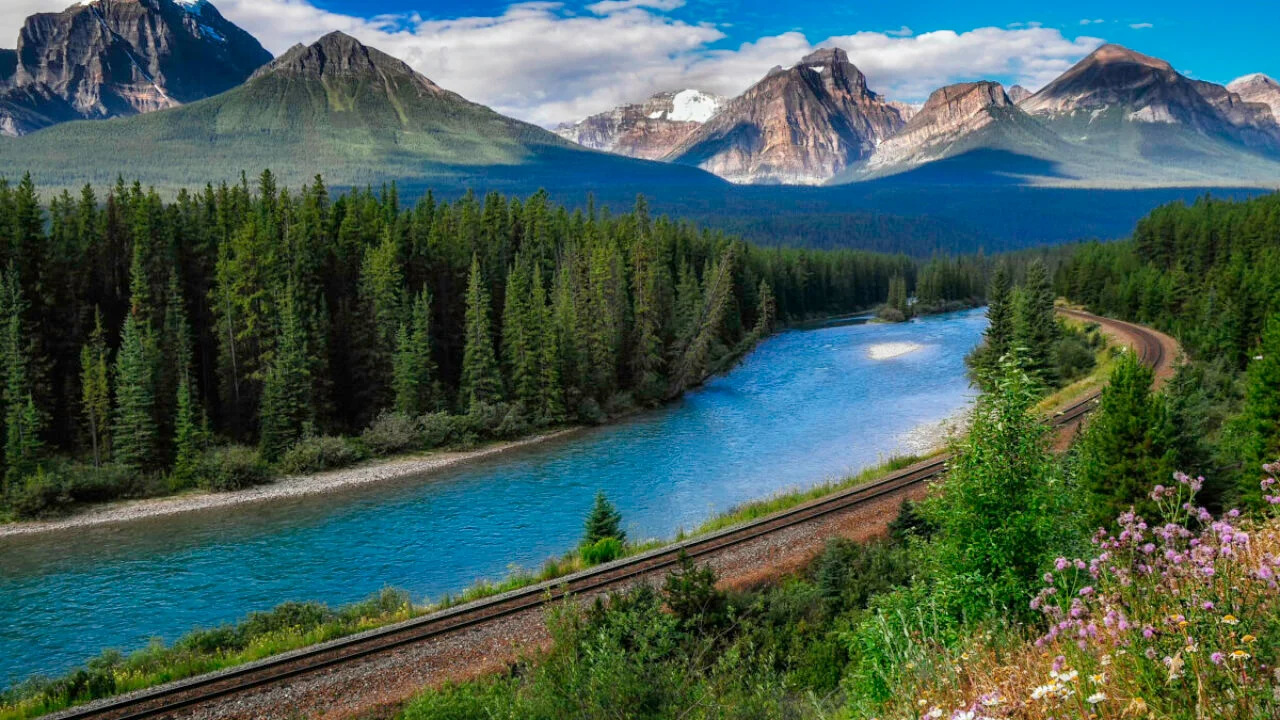
If you've ever seen a postcard of a train winding through the Canadian Rockies with mountains and river behind it, there's a reasonable chance it was taken here. Morant's Curve is a bend in the Canadian Pacific Railway track named after Nicholas Morant, a CP Rail photographer who worked this location extensively from the 1940s onward and made it one of the most recognised railway images in North America.
The combination of elements — the curve of the track, the Bow River in the foreground, the mountains behind — is almost impossibly photogenic. Trains pass at irregular intervals, so photographers often wait 20–40 minutes between shots. Bring a telephoto lens if you have one. The pull-off is small but clearly signed on the parkway.
Castle Mountain Viewpoint
Castle Mountain looms at 2,766 metres and has one of the most distinctive silhouettes in Banff National Park — a long, flat-topped ridge with vertical limestone walls that genuinely looks like a castle from the valley floor. The viewpoint on the Bow Valley Parkway gives you a clear, unobstructed view across open meadows to the peak. In autumn, the aspens turn gold against the grey limestone and the mountain turns orange in afternoon light.
Castle Junction — where the Bow Valley Parkway meets Highway 93 South — is nearby and worth a brief stop. A small general store here has been serving travellers since the 1920s.
Backswamp Viewpoint & Wetlands
Just a few kilometres from Banff, Backswamp is one of the best birdwatching spots on the entire parkway. The wetland sits in a former oxbow of the Bow River and attracts waterfowl, songbirds and raptors throughout the year. In spring and early summer, it's common to see osprey, great blue herons and various ducks using the area. Elk also feed in the surrounding flats — early morning visits in autumn are particularly good for elk activity.
Silverton Falls
A short 1.8-kilometre return trail from a parking area on the parkway leads to Silverton Falls — a 35-metre waterfall that sees a fraction of the traffic Johnston Canyon does. If you want a waterfall experience without crowds, this is it. The trail is relatively easy and the falls are genuinely beautiful, especially in late spring when snowmelt keeps the volume high.
Bow Valley Viewpoint
Positioned to give a sweeping view back down the Bow Valley toward Banff, this lookout is one of those spots where you stop for five minutes and end up staying for twenty. On a clear day you can see the valley stretching back toward Banff with the Fairholme Range on the east side and the Sawback Range on the west. It's a natural orientation point that helps visitors understand the scale of the landscape they're travelling through.
Wildlife on the Bow Valley Parkway
The Bow Valley Parkway is one of the most productive wildlife corridors in Banff National Park. The combination of forest, open meadows, river flats and wetlands creates habitat for a remarkable variety of animals — and the slower speed limit and lower traffic volume compared with the Trans-Canada means encounters are much more likely and much less stressful for the animals.
- Elk — common year-round, especially in meadows near Backswamp and Castle Junction. Bulls are most visible during the September rut
- White-tailed and mule deer — frequently seen in the forest edges at dusk and dawn
- Black bears — most active from May through October, often feeding on berries in late summer and autumn
- Wolves — the Bow Valley is home to several wolf packs. Sightings are uncommon but possible, especially in winter
- Bighorn sheep — often seen on rocky slopes near Castle Mountain and along the valley walls
- Coyotes — frequently spotted hunting in open meadows, often visible even in midday
- Birds — great grey owls, Clark's nutcrackers, osprey, kingfishers and bald eagles have all been recorded on the parkway
The golden rule: always observe from a safe distance, never feed wildlife, and follow Parks Canada guidelines. If traffic stops for wildlife — and it will — keep your vehicle to the side of the road and stay inside or at least close to your vehicle.
Photography on the Bow Valley Parkway
The Bow Valley Parkway is legitimately one of the best photography destinations in western Canada. Morant's Curve for trains and reflections, Johnston Canyon for waterfalls and canyon light, Castle Mountain for landscape and golden hour, the wetlands near Backswamp for birds and elk, and the general river valley for mountain reflections in the Bow River.
The best light on the parkway is in the early morning — the valley runs roughly east-west, so the eastern peaks catch the first light while the western faces go warm in the last hour before sunset. For wildlife photography, arrive before 7am in summer and plan to stay until at least 9am. The animals are active, the light is soft, and the road is quiet.
Bow Valley Parkway vs Trans-Canada — Which Should You Take?
If you're driving from Banff to Lake Louise for the first time and you have any flexibility in your schedule, take the Bow Valley Parkway. It adds perhaps 15–20 minutes of driving time (before stops) but delivers an experience that's completely different from a motorway transit. The Trans-Canada exists to move vehicles efficiently. The Bow Valley Parkway exists to let you experience the landscape.
The ideal approach — if your schedule allows — is to take the Bow Valley Parkway one direction and the Trans-Canada the other, which gives you both the scenic experience and the efficiency without sacrificing either.
Do You Need a Parks Canada Pass?
Yes. The Bow Valley Parkway runs entirely within Banff National Park, so all passengers in your vehicle require a valid Parks Canada pass. A day pass covers one vehicle and all its passengers for a calendar day. An annual Discovery Pass covers the vehicle and occupants for one year at all Parks Canada sites — good value if you're visiting more than once or combining Banff with other national parks. Passes can be purchased online in advance or at park gates on entry.
Why Take the Bow Valley Parkway with a Private Chauffeur?
Driving the Bow Valley Parkway is a genuinely different experience when you're not the one driving. When you're behind the wheel, your attention is split between the road, the wildlife, the camera and the map. A private chauffeur from Calgary Airport or from your hotel in Banff lets everyone in the vehicle be fully present — watching for animals, taking photos, asking questions and stopping whenever something catches your eye.
Red Mile Limousine Services provides private scenic transfers along the Bow Valley Parkway from Calgary International Airport, downtown Calgary and Banff hotels. Our chauffeurs are familiar with the parkway's best stops, know the seasonal patterns for wildlife and understand how to position vehicles for photography without disturbing animals. Whether you're a first-time visitor wanting to make the most of one day in Banff, or a returning guest who wants to experience the parkway differently, a private transfer changes the entire tone of the journey.
Custom itineraries combining the Bow Valley Parkway with Lake Louise, Canmore, Kananaskis or Fairmont Banff Springs can be arranged for any group size — please call or email for custom trip pricing.
Book a private Bow Valley Parkway transfer
Travel from Calgary or Banff with a professional chauffeur — stop anywhere, photograph everything, worry about nothing. View our rates before booking.
Bow Valley Parkway — Frequently Asked Questions
What is the Bow Valley Parkway?
The Bow Valley Parkway (Highway 1A) is a 48-kilometre scenic road in Banff National Park running parallel to the Trans-Canada Highway between Banff and Lake Louise. It is slower, quieter and far more scenic than the Trans-Canada, with wildlife viewing opportunities, historic stops and some of the best mountain photography spots in the Canadian Rockies.
How long does it take to drive the Bow Valley Parkway?
Without stops, the 48-kilometre parkway takes around 45 minutes to drive. With stops at Johnston Canyon, Morant's Curve, Castle Mountain viewpoint and other attractions, most visitors allow 3 to 5 hours for a relaxed full experience.
What are the best stops on the Bow Valley Parkway?
The top stops include Johnston Canyon (waterfalls and hiking), Morant's Curve (iconic railway photography), Castle Mountain viewpoint, Bow Valley Viewpoint, Backswamp wetlands, Silverton Falls and the Banff Riding Stables. Each stop adds unique value to the journey.
When is the best time to drive the Bow Valley Parkway?
Early morning in summer (June to September) is ideal for wildlife sightings and soft light for photography. Note the seasonal restriction: A designated 17-kilometre eastern section of the Bow Valley Parkway is closed to all travel from 8:00 p.m. to 8:00 a.m. between March 1 and June 25 each year. Restrictions, emergency closures and access conditions can change, so current Parks Canada bulletins must be checked before every trip.
Is any part of the Bow Valley Parkway closed?
Yes, seasonally. A designated 17-kilometre eastern section of the Bow Valley Parkway is closed to all travel from 8:00 p.m. to 8:00 a.m. between March 1 and June 25 each year. Restrictions, emergency closures and access conditions can change, so current Parks Canada bulletins must be checked before every trip. Emergency and wildlife closures can also be added at any time, so check the Parks Canada bulletin before travelling.
What wildlife can I see on the Bow Valley Parkway?
The Bow Valley Parkway is one of the best wildlife corridors in Banff National Park. Visitors commonly spot elk, white-tailed deer, mule deer, black bears, wolves, coyotes, bighorn sheep and a variety of birds including owls and hawks. Early morning and evening are the most productive times for sightings.
Can I book a private driver or limo for the Bow Valley Parkway from Calgary?
Yes. Red Mile Limousine Services provides private transfers and scenic chauffeur tours from Calgary to the Bow Valley Parkway. A private driver allows you to stop at any point along the route without worrying about driving, parking or navigating unfamiliar mountain roads — ideal for photography, families and first-time visitors.
Is the Bow Valley Parkway better than the Trans-Canada Highway?
For scenic beauty and wildlife viewing, absolutely yes. The Trans-Canada is faster but the Bow Valley Parkway offers a completely different experience — slower pace, more stops, far more wildlife encounters and much less traffic. If you have time, always choose the Bow Valley Parkway for the Banff to Lake Louise stretch.
Are there hiking trails accessible from the Bow Valley Parkway?
Yes. Johnston Canyon is the most popular — a canyon walk along metal catwalk bridges to lower and upper waterfalls, accessible from a trailhead right on the parkway. Other trails include Rockbound Lake from Castle Junction and Silverton Falls near Morant's Curve.
Do I need a Banff National Park pass to drive the Bow Valley Parkway?
Yes. The Bow Valley Parkway runs through Banff National Park, so all passengers require a valid Parks Canada day pass or annual Discovery Pass. Passes can be purchased at park gates or online in advance.
What is Morant's Curve and why is it famous?
Morant's Curve is a bend in the Canadian Pacific Railway track near the Bow Valley Parkway, named after Nicholas Morant — a CP Rail photographer who made the location famous in the 1940s. It remains one of the most photographed railway scenes in North America, combining the curve of the track with the Bow River and mountains as a backdrop.